Q: What are automotive AI agents? A: As part of an agentic AI platform, modular AI agents can think, plan, and act in multiple steps to complete complex tasks, learn from experience, and adapt to changing conditions.
Q: How do they improve on older voice assistants? A: Automotive AI agents can evolve independently of the core IVI platform. Instead of shipping a monolithic update, as is done today, OEMs can deploy or refine agents that specialize in new domains without tearing down the architecture. This ensures faster iteration cycles and drastically reduces engineering work, slashing R&D costs.
Q: Can they help build brand loyalty? A: Custom automotive AI agents reflect a brand’s tone, personality, and brand language, far transcending simply playing podcasts or providing sports scores. Automakers can turn every interaction into a moment of connection, making automotive voice conversation an indispensable companion, both inside and outside the vehicle.
From Software-Defined to Intelligence-Driven: The Agentic Shift in the Automotive Experience
Agentic AI is transforming industries at an unprecedented pace, as organizations around the world pilot and deploy systems that can think, reason, and act autonomously. Now, that same momentum is reaching the automotive sector. The ability of agentic AI to orchestrate multiple automotive AI agents to handle complex, multi-step tasks through voice or text is redefining what’s possible inside the cockpit.
Even today, most in-car voice assistants operate within rigid domain boundaries, handling one task at a time, rather than orchestrating multiple goals.
For years, SDV has promised to revolutionize how cars are built, updated, and experienced. But SDV’s promise is only partially realized. While SDV enabled automakers to push updates faster, many automakers still remain constrained by siloed domain development and complex, costly engineering cycles. Adding new functions or integrating fresh data streams, including previously difficult-to-access unstructured data such as screen input to open windows or adjust temperatures, still takes months of work. Even today, most in-car voice assistants operate within rigid domain boundaries, handling one task at a time, rather than orchestrating multiple goals.
AI for Automotive: A New Blueprint for the Intelligent Cockpit
Because AI agents are modular, they can be easily updated to include features, data sources, and behaviors to carry out requests and they can evolve independently of the core IVI platform. Instead of shipping a monolithic update, as is done today, OEMs can deploy or refine agents that specialize in new domains — infotainment, personalization, maintenance, or commerce, for example — without tearing down the architecture. This not only means faster iteration cycles and lower integration cost, it also means drastically reduced engineering work, slashing R&D costs.
For OEMs, the impact can be transformative:
Rapid iteration — agents evolve independently of the core IVI platform, cutting development cycles.
Lower R&D costs — modular agents mean less re-engineering, more innovation.
Scalable architecture — new domains can be added or refined without reworking the entire system.
New revenue streams — agents open access to an estimated $35B+ commerce monetization market.
Building Trust, Loyalty, and Brand Ownership
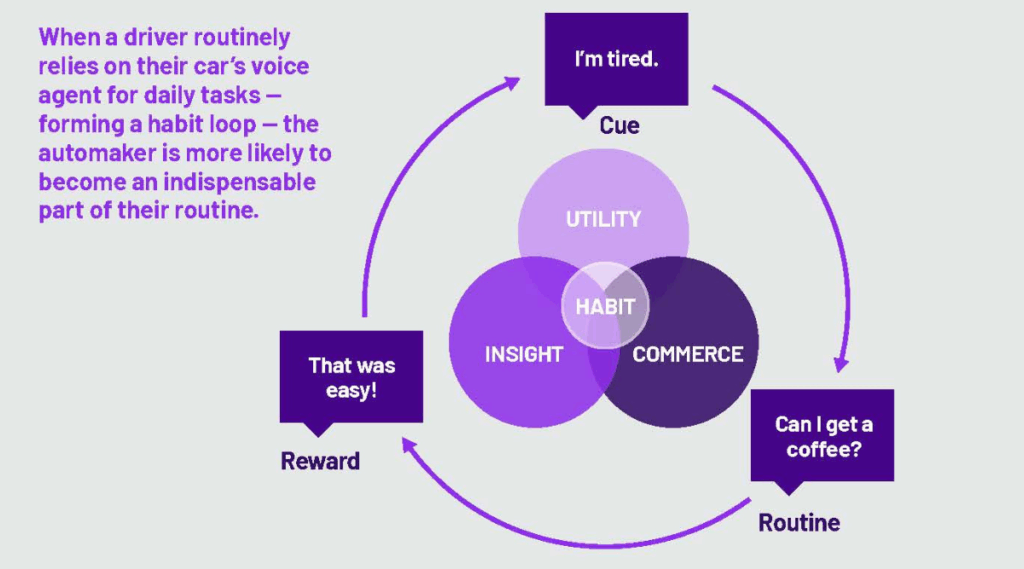
Agentic platforms also enable OEMs to build more personalized and customizable brand assistants, and to unlock capabilities that help form brand-positive driver habits, which help build loyalty and trust.
Agentic accomplishes this with onboard memory that can store driver preferences and learn how to better service drivers. It could be as simple as requesting the assistant to “be less chatty” or to request temperature or radio settings each morning or at nighttime. Or more complex such as creating and storing a frequently-needed driver query spanning multiple domains from inside and outside the car:
“Book me a reservation at Tad’s steakhouse, find parking nearby, no more than $25, and give me a rate for my favorite hotels if I choose to stay the night (reservation agent, parking agent, hotel agent).”
This would not only integrate brand tone and styles, but also custom wake words to activate the assistant through a branded prompt such as “hey Kia” or “hello Lucid.”
Through Model Context Protocol (MCP), an open standard that allows AI models to connect with and use external data, tools, and services, the SoundHound AI platform extends the assistant’s reach beyond the car. This expands OEM access to an estimated$35B+ commerce monetization opportunity, from parking and dining to retail and reservations. Recent announcements include the Soundound AI and Parkopedia voice AI-powered parking search and payment agent, and the OpenTable Reservations AI Agent in partnership with OpenTable.
This new voice commerce opportunity also creates loyalty.
Contrast this experience with an AI assistant that simply plays podcasts or provides sports scores when prompted. While these capabilities are helpful, they have far less influence on building OEM brand loyalty.
When custom voice agents reflect the brand’s tone, personality, and brand language, automakers can turn every interaction into a moment of connection, making automotive voice conversation an indispensable companion, both inside and outside the vehicle.
Why SoundHound AI
SoundHound AI integrates all of these capabilities in the SoundHound AI Agents for Automotive platform. The platform combines SoundHound’s advanced ASR, Polaris, and real-time LLM orchestration, to enable our in-car voice assistants to understand complex, multi-domain requests and respond naturally in context.
SoundHound AI’s Agentic+ framework also unlocks previously inaccessible SDV data — such as digital inputs from vehicle controls or environmental systems — making it faster and easier for OEMs to build and refine new use cases. The result is a streamlined, lower-cost development cycle that accelerates innovation while strengthening the OEM’s relationship with the driver.
In short, SoundHound transforms the cockpit from a passive interface into an active growth engine.
The Future Is Agentic
The cockpit is no longer a collection of screens and sensors. It’s the driver’s trusted companion, the OEM’s brand ambassador, and the driver’s proactive partner in getting things done.
For OEMs ready to lead the next era of mobility, agentic AI isn’t just the next evolution, it’s the key to unlocking lasting value.
Attending CES 2026?
Sign up for a live demo of our latest in and out-of-car innovations at CES West Hall Booth 5867.
David Barry is the Senior Technical Content Writer at SoundHound AI. He has extensive experience writing about the tech industry’s leading innovations, including AI agents, voice AI, virtual and augmented reality, UX, and much more. He is based in Princeton, NJ, and is driven by a lifelong curiosity about how technology transforms human interaction and creativity.