

Apr 13 2026
Insurance Containment Rate Jumps 3x With Agentic AI
See how a leading Mexican auto insurance company increased call containment rates and resolved requests faster with agentic AI.
Learn More

AI technology is advancing at a rapid pace and helping make companies work more efficiently. There are many different types of AI tools, with agentic AI and generative AI being two of the most popular for businesses. But what’s the difference between these two types of AI, and how does this work in practice?
Both agentic AI and generative AI are based on large language models (LLMs), and they can even work together in some professional contexts. However, they serve different purposes and have different capabilities.
Let’s compare agentic AI vs. generative AI to understand their differences, use cases, and how they can work together to boost productivity.
Generative AI is a type of artificial intelligence that creates new content based on prompts. Depending on the model you use, generative AI can create text, images, code, audio, or even video content. Generative AI can also answer questions and provide feedback.
Some examples of popular generative AI tools include ChatGPT, Claude, and Gemini. These tools are trained on large datasets of existing content to learn how to spot complex patterns and create new content. Many generative AI tools use LLMs to process text prompts.
With generative AI, users will start with a request. For example, they might ask the AI model to generate a graphic for them based on a short description. The AI model then references its dataset and previous interactions to create a graphic that aligns with the prompt. If the user isn’t happy with the output, they can use further prompts to refine it.
Agentic AI is a type of artificial intelligence that is programmed to work autonomously to complete specific tasks or achieve pre-defined outcomes. Agentic AI models can work on their own once they’ve been designed, so they don’t require continuous prompting. Like generative AI, agentic AI tools are often based on LLMs, which help them understand language and spot patterns.
Many organizations now use agentic AI to handle repetitive or time-consuming workflows, boosting productivity without expanding their staff. For example, agentic AI can process customer service requests, allowing organizations to provide 24/7 support. It can also handle sales and marketing outreach, freeing up time for employees to work on high-level strategy and closing deals.
Generative AI and Agentic AI have very different capabilities and use cases. Generative AI requires ongoing human input and focuses on creating content, while agentic AI can work autonomously and can handle complex workflows.
Here’s a breakdown of the key differences between agentic AI vs. generative AI.
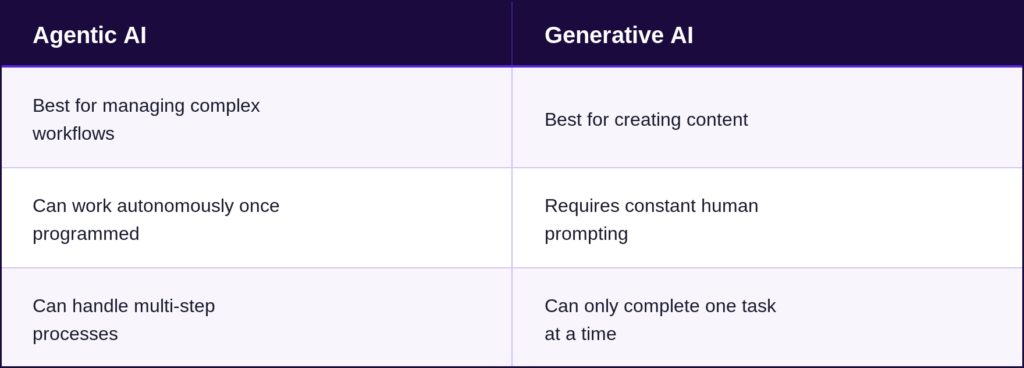
The differences between agentic AI vs. gen AI are very visible in real-world use cases. Let’s break down some of the most notable differences between these two technologies, plus how these differences affect real professional workflows.
Generative AI is best for processing simple, clear prompts and generating content quickly. Agentic AI, on the other hand, can handle complex, multi-step workflows on its own.
If you need help writing an email or just want a quick answer to a question, a generative AI model can provide results in seconds. However, generative AI needs ongoing prompting to work, so it can’t complete tasks that require multiple steps.
For tasks like handling customer service requests, analyzing complex data, or conducting outreach, agentic AI models are a better fit. These tasks take multiple steps to complete, so they need more advanced AI technology that works on its own.
Generative AI tools produce one output at a time, whether that’s generating a static piece of content or answering a question. If the user wants more information or wants to refine the content, they will need to use additional prompts to get those results.
Agentic AI focuses on achieving a specific goal or outcome, rather than creating a specific type of output. The AI agents continue to take action until they achieve this goal, rather than waiting for further human input. An agentic AI model might ask questions, search databases, or complete multiple tasks on its own to complete its objective.
Generative AI tools require ongoing human direction and validation to work. Every output is a direct response to a human prompt.
One of the biggest benefits of agentic AI is that it can operate autonomously once it has been programmed; it works proactively within pre-defined parameters to achieve its goals. Although agentic AI can work autonomously, human oversight is still essential. AI models can make mistakes, so a human employee needs to be available to correct these mistakes when they happen. Human supervision is also necessary to maintain data privacy and adhere to compliance standards.
The difference is that humans don’t need to initiate every interaction with agentic AI. Instead, they can step in periodically to resolve problems and keep things on track.
Both agentic AI and generative AI are valuable tools that can help you work more efficiently and scale your operations. The key is finding the right applications for each tool. Here’s when to use agentic AI and when to use generative AI.
Generative AI works best when you need to create new content quickly and don’t want to start from scratch. It’s helpful for writing the first draft of a new document, testing out ideas for your brand imagery, or even creating code for a new app. Even if the results require some manual editing, generative AI tools can significantly speed up the creative process.
It can also function as a supportive chatbot assistant during the workday, answering questions and providing helpful feedback for additional perspective.
Agentic AI works best when you have complex workflows you want to automate, particularly in customer service. A conversational AI platform can take orders, process payments, and help customers solve problems with minimal human support.
Many organizations are also incorporating agentic AI into their internal operations. IT teams can use AI agents to process support tickets and monitor systems for cybersecurity threats. AI agents are also effective for HR roles like employee onboarding, scheduling, and training.
Both agentic AI and generative AI are hugely effective for operational growth and efficiency, and you don’t have to choose between them.
Some of the most powerful AI solutions combine both technologies in smart end-to-end workflows. A sales team might use generative AI to write cold pitches, then use agentic AI to research prospects and send those pitches in an outreach email.
Here are some of the valuable benefits of combining agentic and generative AI in your operations.
By using these two technologies together, you can automate every step in a workflow from end to end. Generative AI and agentic AI work together to achieve a goal, with generative AI creating the content and agentic AI handling the execution.
Smart AI workflows create memorable experiences that keep customers coming back while helping your employees be more productive. Customers can make purchases and access support quickly and reliably through AI agents, leaving a positive impression that builds brand loyalty.
With integrated AI workflows, employees will spend less time on repetitive, time-consuming tasks. This frees up more time to focus on strategy work and meaningful interactions where human expertise is important.
Since agentic AI works autonomously, it can make decisions and take action in real time. AI agents can work 24/7, allowing organizations to solve problems as they happen.
With SoundHound, you can create intelligent, voice-enabled AI systems that transform your organization. SoundHound offers AI for automotive, AI ordering systems, AI voice assistants, and more, combining conversational AI with agentic capabilities. With autonomous AI agents on your team, you can work more efficiently while delivering quality experiences for customers. Get in touch with our team today to learn more about our conversational AI solutions.
When comparing gen AI vs. agentic AI, the biggest difference is that generative AI creates content by responding to prompts, while agentic AI works proactively to solve problems.
Yes, in many cases, agentic AI can either replace or work with generative AI to complete the same tasks. While generative AI requires consistent human prompting, agentic AI can operate autonomously, which can make it work faster.
When working together, generative AI creates content, while agentic AI manages the workflows and interacts with external systems.