

Apr 13 2026
Insurance Containment Rate Jumps 3x With Agentic AI
See how a leading Mexican auto insurance company increased call containment rates and resolved requests faster with agentic AI.
Learn More

Growing companies don’t always have the time or resources to answer every customer question manually. But failing to respond to interested customers could lead to lost sales and poor reviews. Chatbots and conversational AI are two technologies that address these problems.
Both chatbots and conversational AI are digital tools that can answer customer questions for you. The difference between these technologies lies in their capabilities: chatbots follow a strict set of prescribed rules, while conversational AI has more advanced natural language capabilities.
Implementing these technologies for your business can help you improve the customer experience as you scale. Let’s compare the differences between a chatbot vs. conversational AI and when it makes sense to use them.
Chatbots and conversational AI can both automate interactions between brands and humans. While many businesses use them to handle customer interactions, they can also handle internal operations as well.
These two technologies are often used to achieve similar goals, but they have very different capabilities. The key difference between the two is that conversational AI uses much more advanced natural language processing (NLP) models, which means it can handle a wider range of topics and is much more flexible.
Here’s how each technology works.
Chatbots are tools that use machine learning to have conversations about specific topics or scenarios. Chatbots are common in online customer service, so if you’ve visited a website for help with a product or service before, you may have interacted with one.
Most chatbots use rules-based programming for their responses. This means that instead of having an open-ended conversation, the chatbot can only respond to input based on very specific parameters. For example, they may respond using a script, a menu of approved answers, or a decision tree with predefined logic.
In short, chatbots can address very specific questions or concerns, but their applications are limited.
Conversational AI uses advanced AI models to have conversations with customers or employees. These AI tools have incredibly strong natural language processing and understanding, so they can handle complex topics and even solve problems on their own.
On top of that, conversational AI improves over time based on feedback from users. These AI models do require programming to align with your brand goals, but once they’ve been programmed, they can usually operate on their own.
Conversational AI can also support voice AI, so customers can feel like they’re actually talking to a person.
There are several notable differences between chatbots and conversational AI. These differences become clear when applying these technologies in real-world scenarios and comparing their performance.
When comparing a conversational AI vs. a chatbot, conversational AI demonstrates natural language understanding capabilities that a standard chatbot can’t match. Chatbots are only programmed to look for specific words and phrases and provide pre-programmed responses, rather than understanding entire user requests. As a result, there are various points in a conversation where chatbots fail to respond in a way that helps customers achieve their goals.
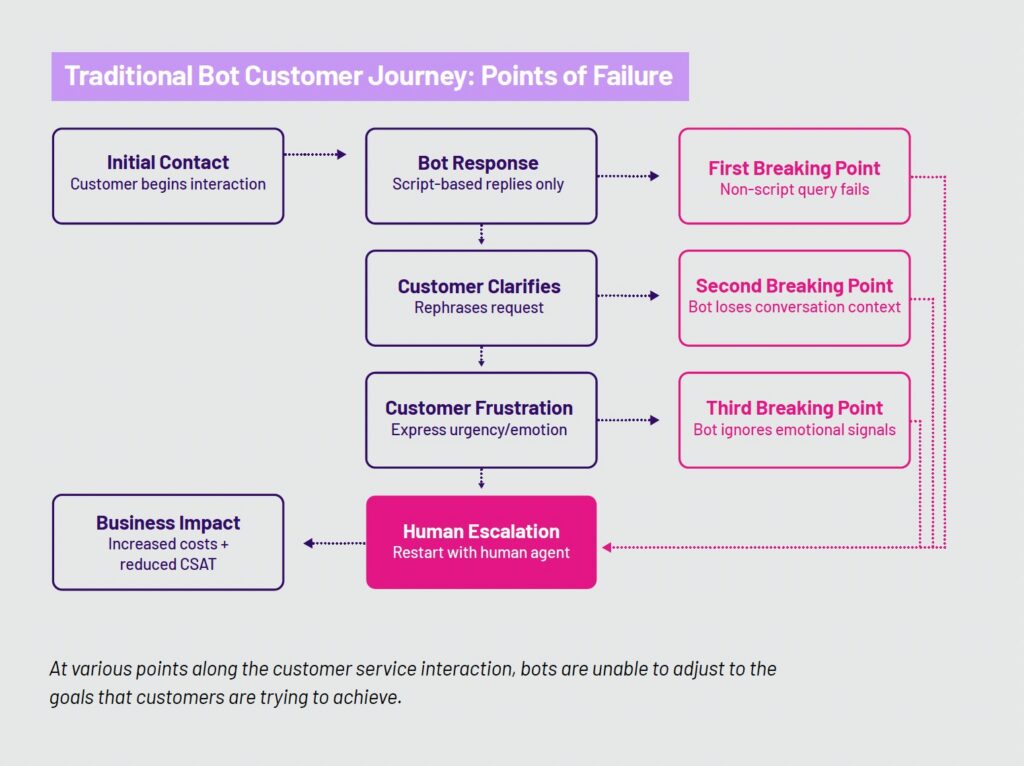
With its advanced understanding, conversational AI picks up on context and nuance in user requests. Instead of just assessing the words in each query, the AI understands why users are asking specific questions. With this added context, conversational AI is more likely to provide a complete, appropriate response to each query.
Conversational AI typically uses a large language model, or LLM, as a foundation. LLMs are trained on huge volumes of language data. As a result, they can handle complex, multi-layered conversations. In some cases, they can even replicate the experience of talking to a human customer service agent.
Chatbots, on the other hand, can only handle very simple conversations. Many chatbots will even require users to choose responses from a menu, rather than allowing open-ended responses.
Conversational AI actively assesses the context behind each user request. As a result, it generates highly personalized responses, with each response tailored to the user’s unique requests.
Chatbots aren’t able to personalize their responses. Instead, they provide generic or pre-determined responses based on specific keywords.
Conversational AI tools are designed to integrate with your existing systems. For example, they can connect to your data warehouses or servers to access a wealth of knowledge about your brand and your operations. Having so much information readily available makes it easier for the AI to handle complex requests.
Traditional chatbots can also integrate with your existing systems and data. However, they need to be explicitly programmed on how to use the data. The chatbot won’t be able to process information from your systems on its own.
Both chatbots and conversational AI can be very useful in the right context. Here’s when to consider using each.
Chatbots are a low-cost way to automate simple, repetitive interactions that aren’t likely to turn into complex conversations. If you don’t have the budget for advanced conversational AI, chatbots could be an alternative, though chatbot flexibility and scalability are very limited.
For example, maybe your customers tend to ask the same few questions over and over again when evaluating your product for the first time. By adding a chatbot to your website, you could answer these questions quickly and route customers to a human support representative when necessary.
Conversational AI has a huge range of viable use cases. It works in virtually any customer service scenario, and can also provide internal support for IT, HR, and many other departments.
Conversational AI works best when you want to automate complex, high-value conversations at a specific point in your sales cycle or operations. A voice-powered conversational AI platform can make these interactions feel even more natural for customers.
Overall, conversational AI tools offer many unique benefits that traditional chatbots can’t match. One of the biggest benefits is the ability to handle complex, layered interactions, which results in a better user experience. Because conversational AI has advanced language processing capabilities, it responds directly to each unique request, rather than providing generic responses that can be frustrating for users.
Conversational AI also helps businesses operate more efficiently. Conversational AI tools can operate 24/7 to answer customer queries, providing fast response times for customers. With AI handling these repetitive questions, staff have more availability to focus on high-value strategic work. Over time, it can help organizations reduce operational costs while scaling to accommodate a higher volume of customers.
One of the biggest benefits of conversational AI is its flexibility. This technology adapts seamlessly to different industries, and many companies have already adopted it to automate key customer interactions. Here are some of the top conversational AI use cases across industries.
Conversational AI works well for customer service centers where teams need to process a large number of customer requests at once. The conversational AI addresses the customer’s problem and either finds a solution on its own or directs the customer to an appropriate human representative.
Fast-casual restaurants are beginning to implement a conversational AI ordering system, where a voice AI takes the customer’s order, provides recommendations, and sends the order to the kitchen. This gives staff more time to focus on making high-quality dishes and keeping the restaurant clean.
Many car manufacturers are now considering voice AI for automotive products. In this use case, a conversational AI assistant is part of the car’s operating system. As you’re driving, the AI can give the driver directions, provide recommendations for nearby activities, or even place orders at nearby stores and restaurants. This helps drivers get the information they need while staying focused on the road.
In the healthcare industry, conversational AI helps patients with administrative necessities like finding appointment times, paying bills, or processing prescription refills. Healthcare organizations often struggle with employee burnout, so conversational AI can take some of these repetitive tasks off their plate.
Conversational AI can also help customers in financial services. Conversational AI handles tasks like bill pay, loan management, or even potential fraud reports. This technology can even inform customers about their spending patterns or suggest ways to pay off debt faster, helping customers stay in control of their finances.
When comparing a chatbot vs. conversational AI, both can automate interactions, but only conversational AI has the power to transform your customer experience.
SoundHound’s conversational AI tools create natural, voice-enabled experiences for your customers and your employees. These advanced AI agents integrate with your existing systems and understand customer intent, which empowers them to handle complex tasks. With conversational AI on your side, your team can operate more efficiently while improving the quality of your customer experience. Talk to an expert today to learn more about our conversational AI tools.