OASYS Edge: embedding agentic intelligence into vehicles and smart devices
Bring the power of agentic reasoning and orchestration to the edge, without a constant cloud connection.

SUBSCRIBE
Until now, businesses building voice AI experiences for vehicles and smart devices have had to compromise.
Rule-based embedded systems respond quickly, but are designed to match predefined commands to individual functions. Cloud-based AI is powerful and reasons through complex requests, but is limited by connectivity requirements and unpredictable operating costs.
SoundHound’s OASYS Edge embeds the power of agentic reasoning and multi-agent orchestration directly into vehicles and smart devices. Voice assistants can now turn one spoken request into a coordinated action across multiple functions by understanding the person’s goal, reading the current context, and orchestrating the right AI agents in real time.
Agentic intelligence runs fully on-board, within the vehicle or device’s own computing environment. Voice assistants only turn to the cloud when a request genuinely requires live online information or a connected service. Businesses may also build an AI agent once and deploy it anywhere: edge, cloud, or a hybrid of both.
With OASYS Edge, manufacturers and service providers can deliver embedded intelligence that reads the moment, handles the details, and lets people focus on what matters.
Why embedded voice AI needed to evolve
Traditional embedded voice systems have helped people control vehicle and smart device functionality for years. However, most systems are rule-based, meaning product teams manually define commands and the responses associated with each one — the classic deterministic approach that voice assistants were previously built on.
These systems work well when requests are explicit, such as “set the temperature to 70 degrees.” They can even understand natural statements such as, “I’m cold,” and recognize them as a request to adjust the climate. However, the response is still predefined. Traditional systems don’t reason across the current state of the vehicle or environment to determine whether that action, another action, or a combination of actions would best address the person’s need.
This scenario makes the limitation clear. When a driver says, “It’s freezing in here,” it might be because an open window is letting in cold air. Or the cabin may already be warming up, but the driver’s heated seat remains off. Choosing the right response requires a system that considers all of that context and coordinates the appropriate vehicle functions.
This is where AI agents on the edge come in.
How SoundHound brings agentic reasoning on board
SoundHound has spent years building embedded voice technology for automotive and smart devices, where response time, reliability, and privacy have always mattered. Our longtime edge capabilities established a strong foundation for voice-enabling devices without a cloud connection.
OASYS Edge is the next major step forward.
At its core is a proprietary model developed around specialized use cases, with intelligence concentrated on functions available on-device. In a vehicle, those functions include climate, seats, windows, vehicle settings, media, and several other supported capabilities. The model being purpose-built for the product it supports is what makes advanced reasoning possible within edge computing constraints.
Now when a person speaks, the embedded voice assistant interprets the intent behind the request. An orchestrator then determines which AI agent or agents should respond, and coordinates their actions. The selected AI agents work in parallel and use available context, like settings, sensor data, or device state, to make the optimal decision and take action.
This fundamentally changes the central question that embedded voice systems need to answer. A rule-based assistant asks, “Which known command does this request match?” OASYS Edge asks, “What is this person trying to accomplish, and which actions can help?”
The cloud remains part of the architecture. Requests that require online information and action are directed to the cloud, while everything that can be handled locally stays local. For example, a driver could say, “Find me a top-rated Thai restaurant along our route, book a table for 2 at 6pm, and navigate there.” The voice assistant searches locally using available on-board spatial and menu data. Once the driver confirms their restaurant choice, the assistant connects to the cloud only for the step that requires an online service: booking the table. It then returns to on-board navigation.
Manufacturers and service providers also have the flexibility to build an AI agent once and deploy it on the edge, in the cloud, or across a hybrid configuration, depending on the unique needs of the device and use case.
What OASYS Edge feels like in practice
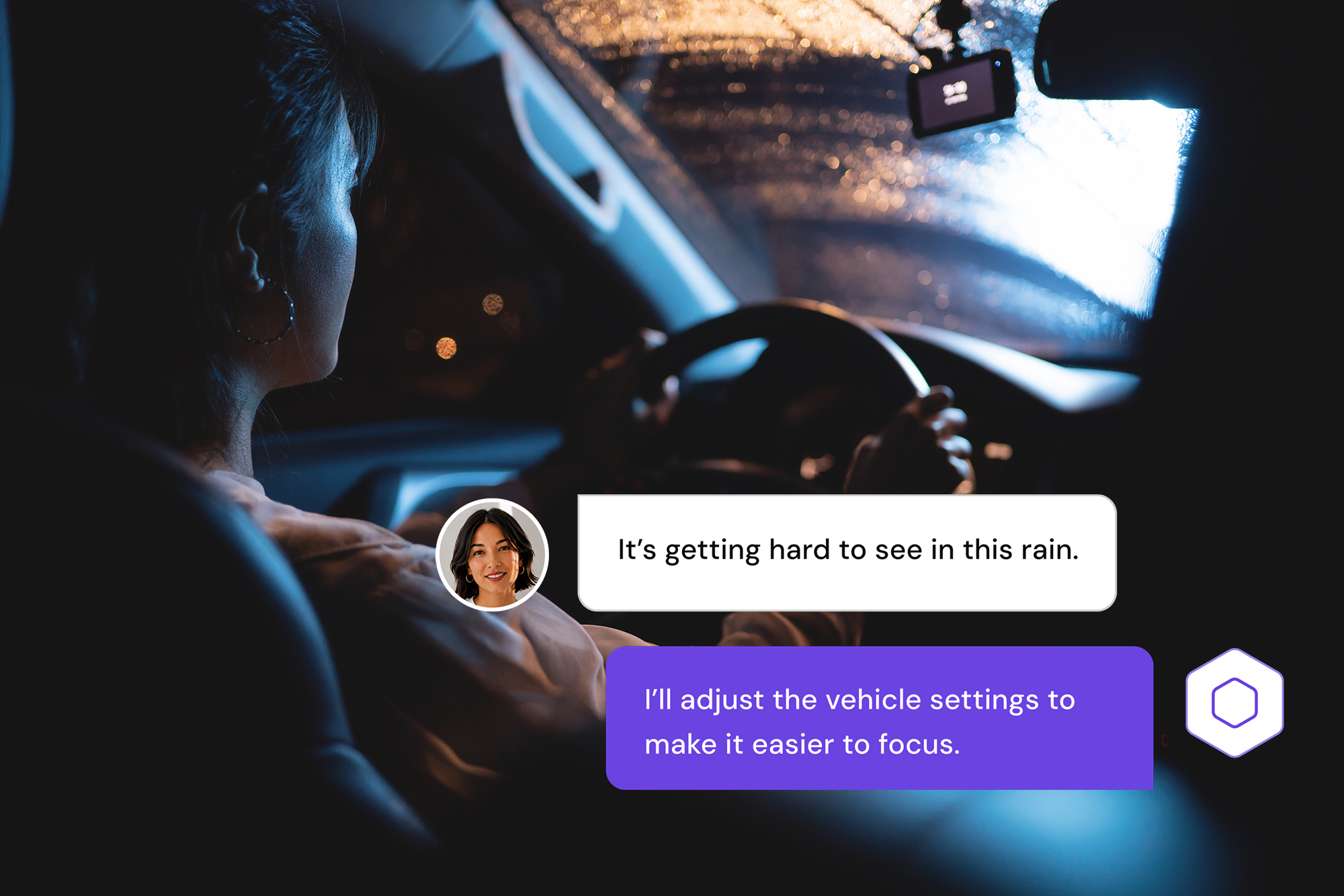
Picture a driver traveling at night as rain begins to fall. Visibility is getting worse, and the driver says, “It’s getting hard to see in this rain.”
The driver has described the problem without specifying what the vehicle should do. In a suitably-equipped vehicle, several systems can work together to make the difficult driving conditions easier to manage.
OASYS Edge considers the time of day, current weather conditions, and the state of the vehicle, then coordinates the appropriate local agents. The vehicle control agent adjusts the windshield wipers to the rain. The windows agent closes any open windows, while the lighting and mirror agents select the appropriate headlight settings and activate available anti-glare features. At the same time, the media agent lowers the volume, and the vehicle settings agent dims and simplifies the dashboard display so the driver can focus on the road.
The driver does not have to issue a series of commands or search through settings while visibility is already limited. One natural statement is enough for the voice assistant to understand the need and coordinate the necessary action.
Built for responsiveness, privacy, and control
For users, the most immediate difference is how responsive, accurate, and dependable the voice assistant feels. Handling requests locally means queries are answered at a natural conversational pace. Because agentic intelligence runs on-device, it also remains available when connectivity is weak or unavailable, such as when a vehicle is in a tunnel or a smart device loses its network connection.
For businesses, the value goes even further:
- Requests handled on-device don’t leave the device. This allows manufacturers and service providers to protect user privacy and reduce the amount of information sent to external systems, which is an increasingly important consideration for customers and regulators.
- Local processing lowers the cost of frequent use. While cloud requests each carry a small processing cost, which adds up across millions of products and years of use, on-device interactions don’t carry that same request-by-request cost.
- Businesses control the experience. The language model can be tuned for the brand, the device, and its unique capabilities. This also allows manufacturers and service providers to deliver a more consistent experience, as changes and updates are within their control instead of with a third-party provider.
The future of embedded intelligence
With OASYS Edge, intelligent reasoning and multi-agent orchestration happens where the experience takes place.
As computing advances for vehicles and smart devices, we believe this approach will become the expectation. Users want to speak naturally, address several needs in one request, and trust their products to keep helping even when connectivity drops. OASYS Edge enables manufacturers and service providers to offer that intelligence with greater ownership of the experience and control over the economics behind it.
This is what the next generation of embedded intelligence looks like.


Experience SoundHound
Learn how OASYS AI agents handle your conversations in the real world.
Experience AI agents built around your actual use cases
See how we balance flexibility and reliability
Explore how we deliver outcomes that matter to you
Discuss what support looks like